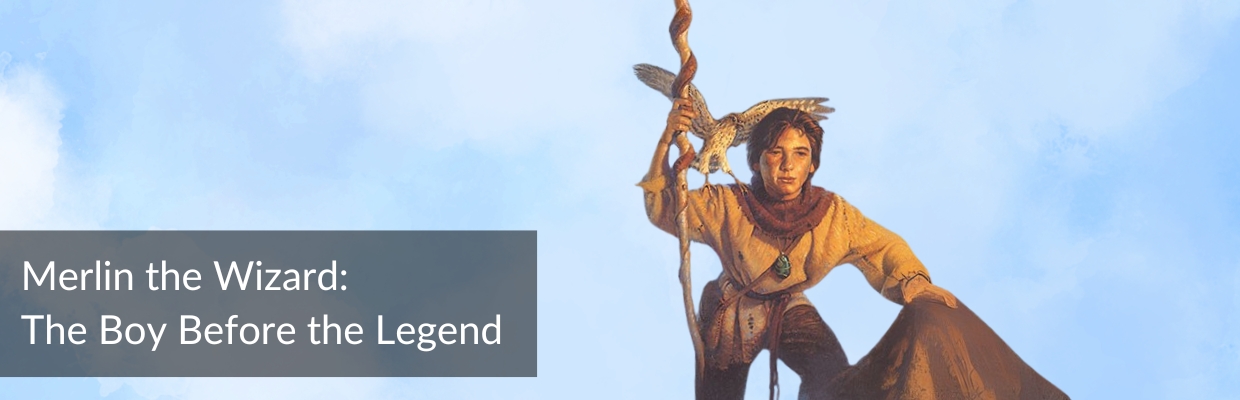
Merlin the Wizard: The Boy Before the Legend
The First Time I Met Merlin
Long before I ever wrote about the wizard, I met him beneath an old oak tree.
At the time, I was a student at Oxford. Whenever I could, I would escape the noise of town and run into the hills beyond the city. On one of those runs, I found an oak perched at the edge of a farm field.
It was enormous — the kind of tree that has held a hill in place for centuries. I could see its age in the thick bark, in the way the branches held the sky.
That tree beckoned for me to sit beneath its branches, and to watch the light change across the valley toward Oxford’s pink granite rooftops. I kept returning to that place, sometimes with a journal or a book to read.
The first book I brought to read was The Once and Future King by T. H. White.
It was there, under that tree, that the wizard Merlin first came alive for me.
Not as the familiar figure from legend, but as someone full of humor and wisdom, mischief and compassion. He was strange, powerful, and deeply alive on the page. The more I read, the more I wondered about the person behind the stories.
Who had Merlin been before he became the most powerful wizard in history?
That question stayed with me for years.
The Dream That Began Merlin’s Story
Nearly twenty years after those Oxford days, after I had returned to Colorado and started writing, I had a dream.
In the dream, a boy was drowning — swept away by waves, desperate and afraid. With all his strength, he reached upward, only for the sea to finally spit him out onto a rocky shore. As he gasped for breath, gulls screeched overhead. He was alive… but everything was gone. He had no memory of his past, no clue of his identity — not even a name.
I woke up and knew: That boy was Merlin.
That dream became the opening scene of MERLIN: The Lost Years, the beginning of a story that would eventually unfold across thirteen books.
But bringing that story to life took time.
It took several drafts before Merlin’s voice felt true. At first, I was trying too hard to make him sound wise from the beginning. That’s when I realized that wisdom had to be earned.
That boy would one day become the most powerful wizard of legend… but not before he faced hardship, loneliness, and difficult questions about who he was and where he belonged.
I didn’t know it yet, but the real story was still ahead of me.
Who Was Merlin Before He Became a Legend?
In most versions of Merlin’s story, we’re presented with the fully formed legend. He’s the wise man, the magician guiding kings. His power is established, and his place is secure.
But that never felt like the whole story to me.
I kept wondering about the time before — before anyone trusted him, before he had any reason to believe his life would matter.
What did it feel like to be him then?
Before the wisdom. Before the power.
What was Merlin like as a child, when nothing in him had yet been named?
What fears shaped him in that silence? What struggles began to form the edges of his wisdom long before anyone called him a wizard?
I kept returning to those questions as I wrote his story.
I didn’t want to write about the wizard who shaped kingdoms, but the boy who wasn’t sure he was worth anything at all.
So Merlin begins with almost nothing.
He washes ashore on an unfamiliar island with no memory of his past and no idea who he is. He has no family, no history. He doesn’t even have a name. He’s frightened, alone, and vulnerable.
That felt deeply true to me.
Because in one way or another, that’s where all of us begin.
The Quiet Choices That Shaped Merlin’s Destiny
In my books, young Merlin starts with nothing.
He’s hungry, cold, and all alone on an unfamiliar shore. And he has to decide: Do I give up? Or do I keep going?
He keeps going.
There’s no heroic moment where he discovers his destiny. There’s just a boy who gets up, moves forward, and finds the smallest reasons to stay alive. Each small choice — to keep walking, to trust the person who offers food, to help someone who needs it — becomes part of who he is becoming.
He doesn’t have a name. People call him by different names until one feels true enough that he claims it. He doesn’t have a memory. So he learns from what’s in front of him: the land, the people, his own choices.
His first acts of courage are quiet ones: choosing to keep moving when he’s afraid, learning to trust when it’s risky, and holding onto kindness when bitterness would be easier.
Those choices shape him. Not in one grand moment, but over time, through a thousand small decisions that no one else witnesses. That’s how character forms. That’s how a boy becomes a wizard.
How Nature Shaped Merlin the Wizard
There’s a scene early in the books when Merlin sits beneath an ancient oak in the Druma Woods and finds himself hearing the world in a new way. The darkness around him is not empty but alive and full of sound: the wind moving through the branches, the water in the distant stream, each carrying its own voice. Beneath it all, there’s a kind of silence, as if the whole forest was listening.
He sits there for hours, listening. And by the time he leaves, he understands something he didn’t before: the world is always speaking. You just have to learn to hear it.
In that moment, Merlin starts to understand that the natural world is not just the place around him but one of his greatest teachers. The forest asks him for awareness, patience, and the willingness to pay attention. In return, he finds his place within that living world.
In my own life, nature has never felt like a neutral backdrop. It has presence, and it has consequences. It doesn’t care about my opinions, nor does it bend to my impatience.
That must have been true for Merlin, too.
When I was writing the Merlin Saga, the land had to be alive. Not alive like a talking tree — that would be too easy. But alive in the way a real place is alive, with moods that can welcome you one day and make you fight for your life the next.
If you move carelessly through a wild place, you miss what matters. But if you slow down and listen, patterns emerge: the wind changes before a storm, birds fall silent before danger. The land has its own rhythm and language.
I wanted Merlin to learn that language.
So Fincayra became more than a backdrop. It became a living presence, with its own logic and rhythm.
Merlin’s journey is not about learning to command that world, but about learning to live within it — to understand that he belongs to the land, and that the land will teach him as surely as any mentor.
Why Merlin the Wizard’s Journey Feels Familiar
Merlin’s legend endures because he begins in the same place as many of us — lost. Washed up on an unfamiliar shore with no name to call him back, unsure of who he is or what he is capable of.
That’s not a comfortable place to start a story. But it’s an honest one.
In the Merlin Saga, he has to build his identity, piece by piece. Through choices, mistakes, and friendships that ask something of him, he slowly becomes himself.
Merlin doesn’t receive wisdom like a gift. He earns it — by making choices without knowing the outcome, by trusting people who may betray him, and by staying present when fear would make escape easier.
In the books, he learns by trial. He watches the land until it makes sense to him, and people until their intentions become clearer. He makes mistakes and survives them. Sometimes he helps someone and only later understands what it meant. And sometimes he refuses cruelty when it would have been easier not to.
None of this is dramatic or quick, but it is real in a way that stays with us.
I’ve written many scenes with Merlin. Scenes with dragons and battles and prophecies, with magic that shakes the earth. But the moments that stay with me are quiet ones: A boy choosing restraint when he could have struck, listening instead of commanding, resisting the urge to see the world as something to dominate.
That is part of why Merlin still speaks to us after all these years.
Not because of his power, but because of his uncertainty — because he begins with questions instead of answers, forced to become himself one difficult choice at a time.
In one way or another, we all begin as mysteries to ourselves.
And perhaps the real magic — for Merlin, and for us — lies in discovering who we become.