What the Names We Give Animals Reveal About Us
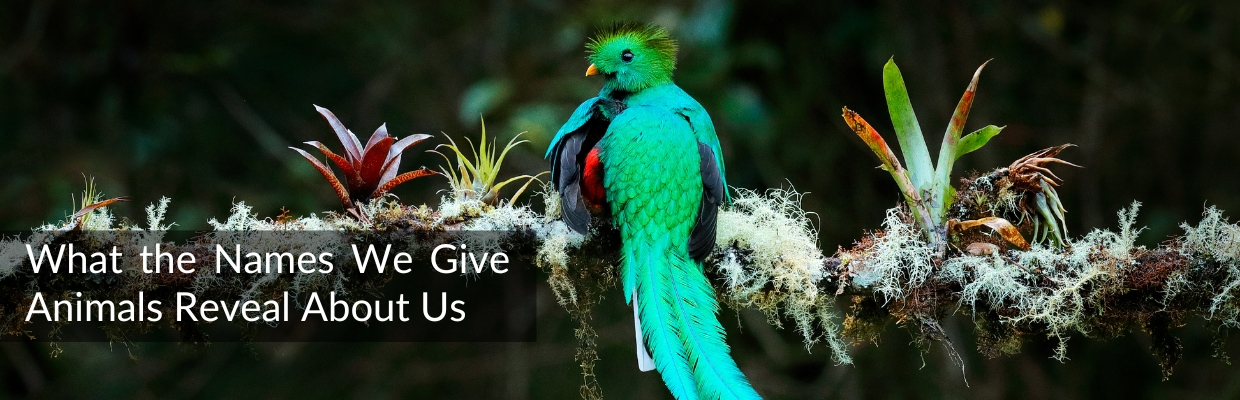
Early one morning, I watched a resplendent quetzal disappear into the canopy of a Costa Rican rainforest.
I had been standing still for a long time, tracing the curve of a branch through my binoculars, when the bird appeared. Its brilliant turquoise, green, and scarlet feathers seemed to glow against the dark leaves, and its long, opulent tail streamed behind it as it moved.
For a few minutes, it made its way along the branch, pausing now and then in a sudden shimmer of color. Then it climbed higher into the leaves and was gone.
I stood there a long time after it vanished.
The quetzal’s name comes from the Nahuatl word quetzalli, meaning “precious feathers.” It is a beautiful name, and not simply because of the sound. It tells us something about how the people who first gave that bird its name saw it: as something precious.
That matters.
A name can be used to classify or describe. It can also reveal relationships — telling us not only what a creature is, but what it means to us.
Names as Relationship
Again and again, while working on Naming Nature, I was struck by how often the oldest names for animals arose from close attention — from people watching carefully, listening patiently, and naming what they observed with both precision and wonder.
The western meadowlark offers one beautiful example.
The Lakota Sioux call this bird tasiyagnunpa, a name that holds the belief that these birds sing of all the goodness in the world. The Cheyenne call it méséhávo’o — “bird of the dawn.”
These names carry affection, observation, and reverence.
Its scientific name, Sturnella neglecta, tells a different story. The second word, neglecta, means “overlooked.” It was named that way by the naturalist John James Audubon, who felt the western meadowlark had been insufficiently appreciated by science.
The irony is striking. A bird whose song the Lakota believed carried the goodness of the universe was named, in Latin, for having been ignored.
Both names are accurate in their own way, but one feels alive with relationship.
Wonder Hidden in a Name
That pattern appears everywhere.
The hummingbird is another case entirely. In English, the name honors the sound of its wings, beating up to 80 beats per second, producing that unmistakable hum.
Other languages hear something different. In the Taíno language of the Caribbean, the hummingbird is colibri, a name that eventually found its way into languages as varied as Czech, German, Polish, and Basque.
But my favorite name for the smallest hummingbird of all — the bee hummingbird, a creature weighing less than two grams — is the Spanish zunzuncito.
Say that word aloud, and you can almost hear the blur of wings in its sound. It feels playful and musical — as alive as the bird itself.
Or consider the American woodcock, affectionately nicknamed the timberdoodle. The Cree call it papakapittesis: “little speckled creatures.” To the Abenaki, its name is nagwibagw sibs, which translates to “under leaf birds.”
These names arrive from patient observation. Someone watched long enough and listened carefully enough to notice where that bird hid, how it moved, and what made it unique.
To name something in this way is to recognize its place in the living world.
When Names Reveal Fear
Not all naming has been so… attentive.
The vampire squid carries the full scientific name Vampyroteuthis infernalis: “vampire squid from hell.” It was given that name because it lives in the ocean’s deepest, darkest zones, with blood-red coloring, and eyes so large they seem almost alien. Everything about the name communicates fear.
The vampire squid is also a living fossil whose ancestry stretches back more than 100 million years. It is extraordinary in ways that have nothing to do with horror.
The name says less about the animal than about our own tendency to fear what we do not understand.
The same is true of the goblin shark. Its Japanese name, tenguzame, refers to the tengu, a mysterious being from folklore. The name carries imagination and cultural memory. Yet in English, “goblin shark” strips much of that richness away, leaving only something grotesque.
The names that we choose shape the way we see, which, in turn, shapes the way we care.
When Names Outlast What They Name
That truth becomes especially poignant when we think about creatures now in decline.
The western meadowlark — méséhávo’o, bird of the dawn — is becoming harder to find as grasslands disappear and pesticides spread.
My mother loved the meadowlark’s song. She used to rise before sunrise and walk the Colorado fields just to hear it. She would’ve been heartbroken to know that their lilting call is now tenuous. She once said that if the meadowlark’s song were to disappear, it would feel like someone had ripped a hole in the soundscape of the American West.
The resplendent quetzal, whose name means “precious feathers,” is also under pressure as deforestation continues to shrink its habitat throughout Central America. And the snow leopard, known to the Balti people as schenn, “mountain ghost,” now exists in dramatically reduced numbers across the Himalayas.
These names were given by people who knew these creatures well — people who watched them closely enough to see not only what they were, but what they meant.
That kind of seeing is a form of care. And when it fades, something precious is lost — not only in the creature itself, but in our relationship to it.
When a Name Becomes Connection
When we learn the name of a bird, a tree, or a wild creature, that life becomes more real to us.
In my introduction to Naming Nature, I wrote that naming inspires attention, attention inspires passion, and passion inspires connection. That thought has stayed with me — because it made me think about all the names we haven’t yet learned, the creatures we pass every day without knowing what to call them, or what their names carry inside them.
The giraffe is indlulamithi in Zulu: “taller than trees.” In Rwanda, it is agasumbashyamba: “the beautiful thing that is taller than the forest.”
These are acts of celebration that say: We have seen you. We know you. You are part of our world.
That is what naming can do, at its best. It draws a circle of attention around a living thing and says: This matters.
In an era when biodiversity is declining faster than at almost any point in human history, that act of naming — careful, curious, reverent naming — feels more important than ever. Not because words alone can save a species. But because the relationship a name represents is the beginning of the will to protect.
The great horned owl asks its question every morning before dawn, in the trees outside my home in Colorado:
Who are you, who?
One honest answer might be: I am someone who pays attention. Someone who learns the names. Someone who, by knowing what to call the living world around me, has taken the first step toward caring whether it survives.
That seems like a good place to start.