Looking Back on The Lost Years of Merlin on the 30th Anniversary
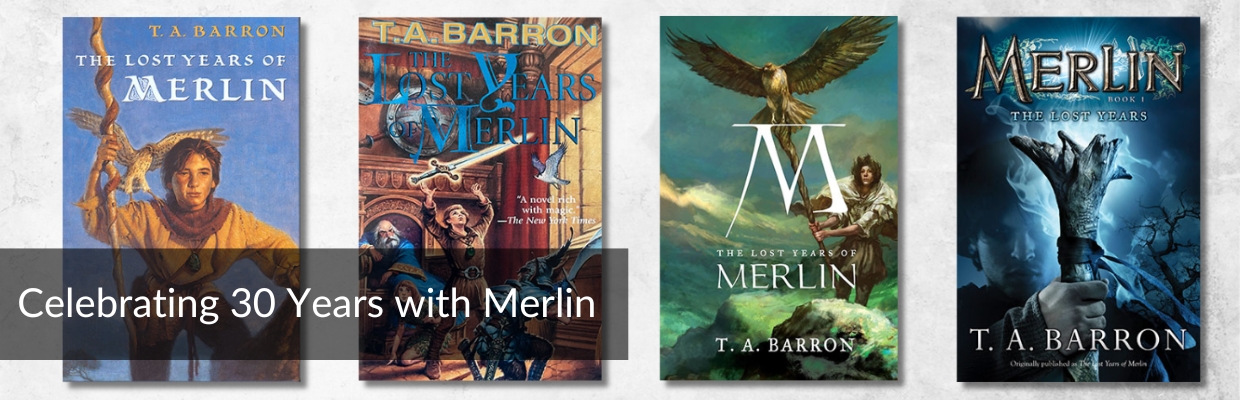
Thirty years ago, on September 9, 1996, a book called The Lost Years of Merlin was published.
At the time, I had no idea that this half-drowned, amnesiac boy would stay with me for the next three decades. I certainly didn’t know that I would write thirteen books set in this universe, or that readers across generations and continents would open their hearts to a nameless, half-drowned boy on a desolate shore. I had no idea that three decades later, I would still be listening to the whispers of the wind through Fincayra or feeling the pulse of the Great Tree of Avalon.
So, on this 30th anniversary of The Lost Years of Merlin, I find myself wandering back to where the magic truly began.
It didn’t start with a publisher’s contract, an outline, or even a blank page. My relationship with Merlin began decades earlier beneath a majestic old English oak in the countryside of Oxfordshire.
How I First Discovered Merlin
When I was in my early twenties, I was fortunate enough to win a Rhodes Scholarship to study at Oxford University. While my studies filled my days, I spent much of my free time running through the rolling hills and quiet woods of the English countryside.
On one of those long runs, I stumbled across a magnificent old English oak tree at the edge of a farm field. It was probably 300 years old or more, with thick, ancient roots anchored deep into the soil and massive branches reaching up into the sky. Beneath its roots, a fox had made its den.
I started to carry a paperback in my backpack on those runs. I would sit beneath that magnificent tree for an hour, resting while looking down at the spires of Oxford glowing in the late afternoon sun. The very first book I pulled out beneath that oak was T. H. White’s The Once and Future King, the book that opened the door for me into the world of Arthur and Merlin.
Sitting there in the shade, surrounded by the scents of earth and leaf mold, I fell completely in love with Merlin.
Of all the legendary figures in Arthurian mythology, Merlin was the one who captured my heart and mind. He was mysterious and wise, yes — but he was also complicated, playful, flawed, deeply connected to the natural world, and fiercely human. Yet at twenty-two, as I watched the shadows lengthen across Oxfordshire, I never thought that twenty years later I would have the privilege of telling stories of my own about this extraordinary wizard.
Then came a dream.
The Dream That Became The Lost Years of Merlin
I can still feel it as clearly as if I woke from it moments ago.
In the dream, a boy was drowning in a violent, tempestuous sea. I remember one image above all: his single, desperate hand reaching out of the dark, churning water. That was all I could see of him. Then the sea spat him out onto a jagged, rocky coastline. Even there, the wild waves kept grabbing at his torn tunic, trying to drag him back down into the depths.
He managed to crawl a few feet higher onto the cold stones and collapsed, shivering and exhausted. Seagulls screamed overhead in the icy fog.
As the boy lay there, he realized he had somehow survived a terrible shipwreck. But then he discovered something even worse: he had lost his memory. All of it. He didn’t know who his parents were. He didn’t know where he came from. He knew nothing about his past — not even his own name.
I woke at about three in the morning, drenched in sweat, still hearing those screaming gulls in my head. Sitting in the dark, my heart pounding, the realization hit me like a flash of lightning: That boy is Merlin.
That frightened, bruised, nameless boy was going to survive that day. And somehow, through trial, hardship, and discovery, he would become the greatest wizard of all time. But first, I had to discover who he was before he became Merlin.
I scrambled out of bed, grabbed my pen, and wrote down the opening lines that had echoed into my consciousness:
“If I close my eyes and breathe to the rolling rhythm of the sea, I can still remember that long ago day. Harsh, cold and lifeless it was, as empty of promise as my lungs were empty of air.”
Those lines came to me in the immediate aftermath of that 3:00 AM dream. But what many readers don’t know is that actually writing the rest of the book proved to be one of the hardest creative challenges of my life.
Finding the boy’s true voice took three full, grueling drafts.
In my first two attempts, I kept falling into a trap. Because I was writing about Merlin — the legendary wizard of fifteen centuries of myth — I kept accidentally giving the young boy the voice of the wise old wizard. He sounded too composed, too knowledgeable, and too preachy. But wisdom isn’t a gift handed to us at birth; it is earned through trial, vulnerability, and mistake.
I had to throw out dozens of chapters and strip away the wizard’s mantle entirely. I had to place myself squarely inside the mind of a frightened, bruised child who woke up on cold, wet rocks with no memory, no family, and no name. Only when I let him be truly lost, uncertain, and human did his real voice begin to speak.
He needed a name, too. In the story, that name is Emrys. As he says at one point, “As many times as she called me Emrys, I could not shake the feeling that my true name was…something else.” I knew he was Merlin, but he didn’t know it yet. For him, discovering that truth becomes part of the story itself.
Creating Fincayra: A Living World Between Worlds
Once Emrys had a voice, he needed a place to grow.
I spent a full year reading Arthurian texts and retellings, from Geoffrey of Monmouth and Sir Thomas Malory to the Welsh Mabinogion and modern masters like T. H. White and Mary Stewart. I realized there was a magnificent tapestry of lore woven over fifteen centuries, but right in the middle was a giant hole: no one had ever told the story of his youth.
To tell that story, I knew he couldn’t begin in Camelot or in a familiar medieval Wales. A boy who had lost his past needed a place that felt lost from the ordinary world, too. He needed a bridge — an enchanted realm lying halfway between the mortal world of Earth and the immortal realm of Avalon. That was how the island of Fincayra was born.
I didn’t want Fincayra to be a passive backdrop. From the Haunted Marsh to the heights of the Misted Hills, Fincayra had to be a living presence with its own moods, rules, and ancient history. The land had to shape Emrys just as much as the people he met there.
In Fincayra, magic wasn’t about waving a wand or reciting easy incantations. Magic had consequences. If you drew upon the land’s power recklessly, it cost you something real. That realm tested young Emrys at every turn, forcing him to learn that true wizardry required listening to the land rather than trying to dominate it.
The Magic of the Seven Songs: Power Grounded in Reverence
One of the greatest joys of writing the original saga was developing the Seven Songs of Wisdom.
When young Emrys journeys across Fincayra, he must master seven distinct powers — including the Song of Healing, the Song of Sight, and the Song of Binding. But I wanted those powers to feel fundamentally different from traditional fantasy magic.
Each song was tied directly to a deep relationship with the natural world. To heal another living creature, Emrys first had to understand suffering and feel true empathy. To gain true sight, he had to look beyond outer appearances and face the dark shadows within his own heart. And before he could wield any real power, he had to learn humility.
Magic, as Emrys comes to realize, does not belong to the wizard. A wizard is merely a humble steward of powers that are greater than himself. That philosophy has guided my writing across every book I’ve ever published. Whether in fantasy or real life, our power grows when we approach the world with reverence, compassion, and wonder.
The Boy on the Shore: A Metaphor for Us All
Of all the images that have stayed with me across thirteen books and three decades, I always return to that solitary boy lying on the wet rocks.
I have come to see him as a metaphor for the human condition. Because at some point in our lives, every single one of us gets washed ashore.
We experience moments when life leaves us bruised, confused, heartbroken, or uncertain of where to step next. Times when circumstance or loss strips away everything we thought defined us, leaving us feeling completely lost.
But the boy on those rocks reminds us of a quiet, enduring truth: being washed ashore is not the end of your story.
It is often the exact moment when your true character begins to form. It is where you choose to stand up, take a deep breath, look out at the wild world ahead, and take that very first step.
Thirty years after The Lost Years of Merlin first reached readers, Merlin is still teaching me. He reminds me to look for wonder in the quiet corners of nature, to build bridges between people, and to trust that even when we feel entirely empty, we carry a spark of magic within us that can never be extinguished.
Thirty Years of Readers: The True Magic
A writer sits alone in a room, sending words out into the dark, hoping they might touch a heart somewhere. But over the last thirty years, the most wondrous part of this journey has been hearing back from you. My filing cabinets and inbox are filled with thousands of cherished letters from readers across three generations.
I think back to the young readers who wrote to me in the late 1990s, telling me how they carried The Lost Years in their backpacks while hiking through the Rockies or the Appalachians. I think of the adults who now write to say they are reading those very same, worn paperback editions to their own children at bedtime. Most of all, I think of the readers who reached out during heavy moments in their lives — times when they felt lonely, bullied, or uncertain of who they were — and shared that Emrys’s struggle gave them the courage to keep walking.
That is the true magic of storytelling. An author crafts a story-boat, but it takes a reader’s imagination and heart to set it free on the water. To know that this half-drowned boy on a distant shore helped someone find their own inner spark is the greatest gift an author could ever receive.
Thank you for walking the trails of Fincayra with me for thirty wonderful years. May you always listen to the whispers of the wild places, care deeply for our Earth, and hold fast to the magic in your own heart.