The History of Dragons
Throughout the history of dragons, one question arises more often than almost any other:
I myself have been asked this question in one way or another in many of the marvelous messages I receive from readers. At first, the answer seems easy: an enormous reptile, perhaps with wings, claws, teeth, and a tendency to breathe fire.
Yet the more closely I try to picture one, the less certain I become. Would its hide feel like rough tree bark or cold river stone? Would it move with the heavy thud of a bear, the sinuous grace of a snake, or the sudden swoop of a hawk? And beyond its appearance, what does it want?
The answers depend on where and when the dragon appears. A Babylonian wall, a Chinese scroll, and a medieval manuscript hold vastly different creatures. Today, we call them all dragons, though the people who first imagined them into existence used very different names.
The History of Dragons Begins in Mythology
When we look back at the earliest history of dragons, some of the oldest ancestors had no wings at all.
From ancient Mesopotamia, we find striking works of art depicting the mušḫuššu, a strange and fearsome mythological hybrid whose name literally translates to “fierce snake.” Associated closely with the god Marduk, vivid images of the mušḫuššu appear on the Ishtar Gate at Babylon, built around 575 BCE, standing proudly alongside lions and bulls.
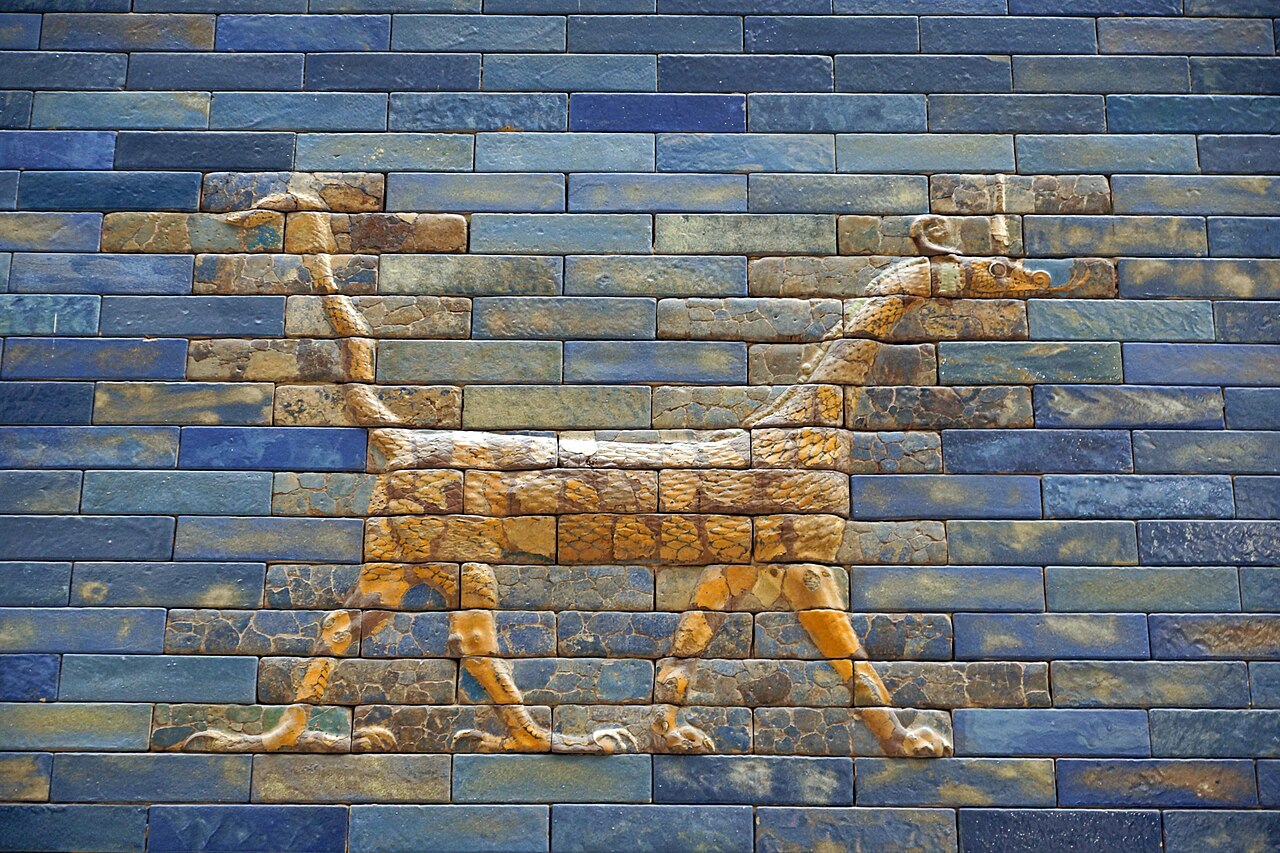
Pergamon Museum, Ishtar Gate, CC BY 2.0, via Wikimedia Commons
Ancient Egypt had its own great serpent of shadow and danger. Apep, sometimes called Apophis, threatened the sun god Ra as he traveled through the underworld each night. The danger returned with the falling darkness, meaning Ra’s passage had to be defended again and again in a perpetual cycle.
In classical Greece, the word drakōn usually referred to an immense serpent with an unblinking, watchful gaze. Python guarded the sacred oracle at Delphi. Ladon coiled around the tree of the golden apples. The dragon tasked with watching over the Golden Fleece in the story of Jason never permitted its eyes to close.
In these ancient traditions, the creatures often guarded a sacred boundary, a legendary treasure, or a profound mystery that heroes could not easily reach.
Dragons of Water, Rain, and the Sky
In other corners of the world, dragon-like beings took on entirely different, life-giving roles.
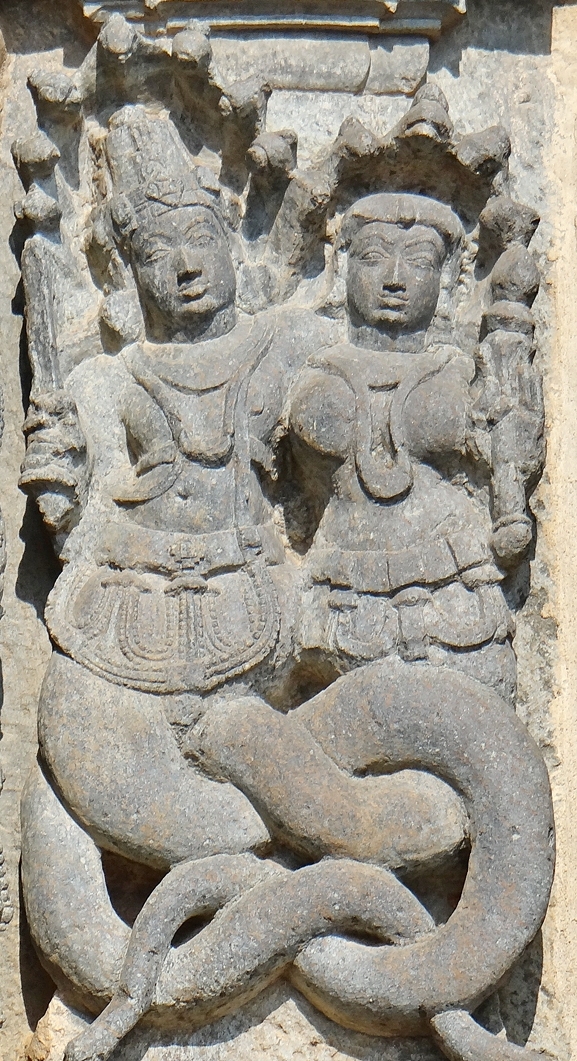
Naga et Nagini, CC BY 2.0, via Wikimedia Commons
In Hindu, Buddhist, and Jain traditions, the nāgas were powerful, semi-divine serpent beings intimately associated with water. They inhabited deep rivers, hidden lakes, and subterranean worlds. While some could be dangerous if provoked, others acted as profound guardians and protectors of nature’s secret wisdom.
Across China, dragons shared this deep connection to the water, but they took a distinct, sky-dwelling form.
The lóng has long been revered as a symbol of seasonal rain, shifting weather, flowing rivers, good fortune, and imperial authority. It is said to glide through clouds and deep waters with equal ease, its elongated body perfectly suited to a world of mist, rain, and mountain rivers.
Over many centuries, Chinese artists masterfully depicted these dragons in jade, bronze, silk, porcelain, and ink. In later imperial China, dragon robes and five-clawed dragons became closely associated with the emperor. In landscape paintings, it might appear only partially through a shroud of cloud or mist, its massive body almost dissolving into the weather surrounding it.
One spectacular 14th-century Chinese ink painting in The Metropolitan Museum of Art’s collection beautifully captures this relationship, showing a dragon emerging directly out of the darkness of a swirling storm.
Mesoamerican traditions provide another remarkable evolution of the archetype: the feathered serpent. Quetzalcoatl, celebrated in Aztec tradition and rooted in even older cultures across Mesoamerica, seamlessly joined the earthbound body of a serpent with the radiant feathers of a bird — uniting two forms of life that would otherwise seem to belong to entirely separate worlds.
Medieval Dragons in Art and Story
A major turning point in the western history of dragons took shape during the Middle Ages.
Dragons began appearing everywhere: in illuminated manuscripts, bestiaries, stone church carvings, stained glass windows, family heraldry, and tales of legendary saints. Some kept the close shape of a serpent, while others sprouted wings, horns, razor claws, elongated necks, leonine faces, or webbed feet.
The sheer variety makes these historical images a joy to study. Some look ferocious enough to crawl right off the parchment, while others seem more likely to ask for directions.
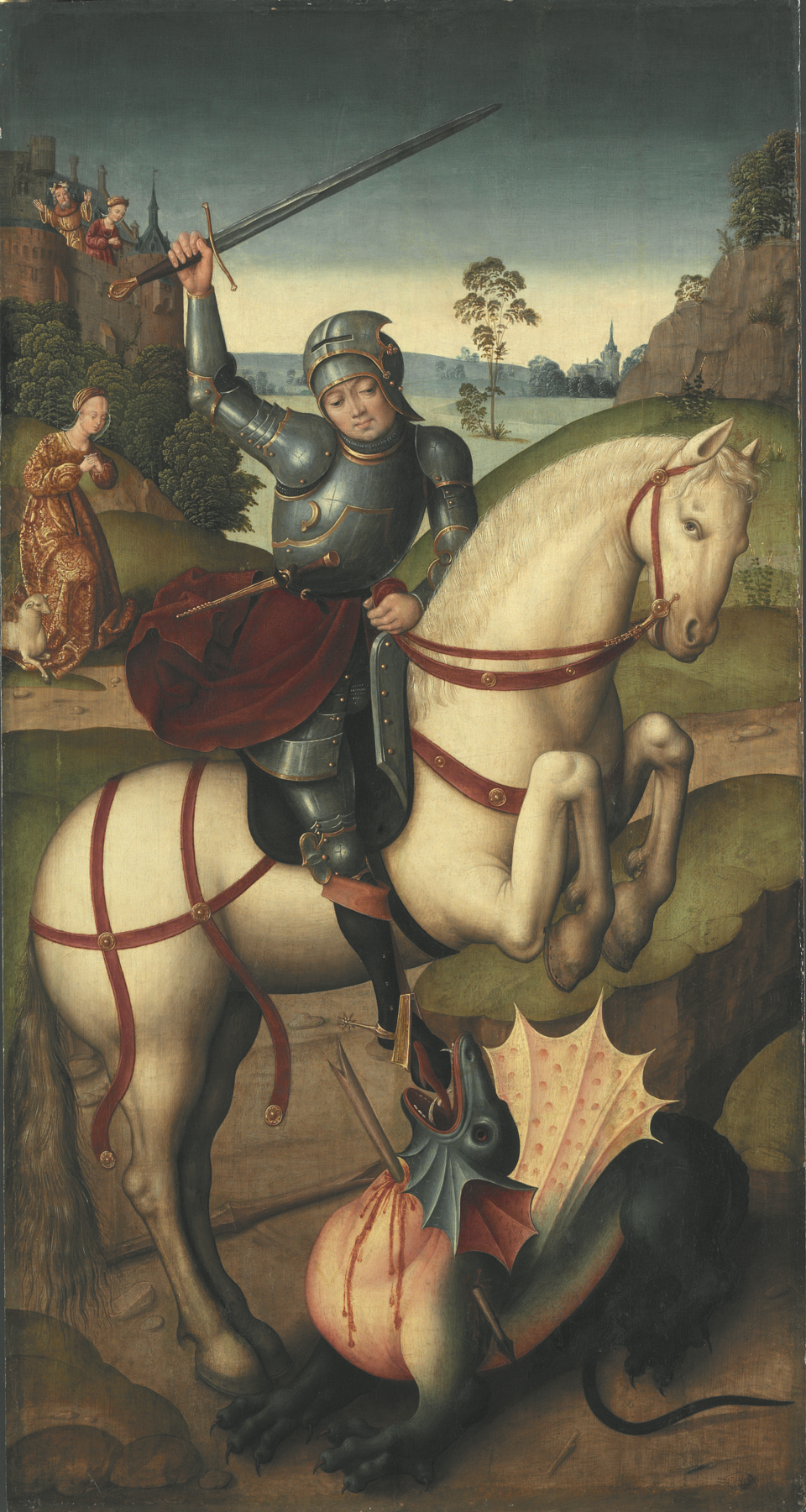
St Catherine, St George and the Dragon, Public domain, via Wikimedia Commons
Medieval Christian allegories frequently portrayed the dragon as a symbol of spiritual danger and worldly temptation. The legend of St. George and the dragon became immensely popular, captured in sculptures and religious texts across Europe as a visible expression of courage, faith, and the triumph over darkness.
Yet the dragon in Beowulf carries a very different kind of literary weight.
The Old English poem, written down around the year 1000, ends with its aging hero facing an ancient dragon guarding a buried treasure hoard. The beast awakens in a fury after a desperate thief steals a single cup from its hidden store, retaliating by raining fire down upon the kingdom. Beowulf manages to defeat it, but he is fatally wounded in the struggle.
Rather than a simple monster, this dragon’s wrath reflects deep literary themes of aging, tragic loss, and the forgotten legacy of a vanished civilization.
Northern European mythologies gave later fantasy another unforgettable dragon in Fáfnir. In the Völsunga saga, Fáfnir begins as a man, murders his father for a cursed hoard, and later takes the form of a dragon to guard it. It is a haunting tale that connects the scales of the creature directly to the human desire for gold, power, and ultimate possession.
Tolkien’s Smaug, it turns out, had very old ancestors.
Dragons as Characters in Literature
By the time Bilbo Baggins meets Smaug in J. R. R. Tolkien’s The Hobbit, the dragon demands the reader’s full attention.
Beyond his roaring and fiery breath, Smaug speaks. He boasts, threatens, and interrogates Bilbo with a razor-sharp intellect as dangerous as his flames. Once a monster is granted a voice, readers must look beyond the teeth and claws to wonder: What has it lost? What does it fear? What does it remember?
Those are the exact questions I find myself asking whenever I create a dragon of my own.
I try to give each important dragon in my books a history, just as I would an important human character. Valdearg, whose name means ‘Wings of Fire,’ begins his true arc in MERLIN: The Raging Fires (Book 3 of the Merlin Saga) as Merlin’s deadly enemy. A tragic confusion over the death of Valdearg’s unhatched offspring has made any hope of peace between them seem utterly impossible.
Yet their conflict shifts beautifully over the course of the story. By the end, Valdearg evolves into Merlin’s most trusted ally. When he tragically dies, he leaves his only surviving child, the young dragon Gwynnia, in Merlin’s gentle care.
Valdearg possesses grief, fierce loyalty, burning anger, and a rich past of his own. His choices grow naturally out of what he has lost and what he still cares about.
Another question that comes up frequently in my letters is whether I would like to have a dragon as a pet. That’s one question I never have trouble answering, since nobody has a dragon as a pet, only as a friend! And they’re very special friends to have indeed.
Dragons are highly selective about the company they choose to keep. They’re incredibly wise, completely fluent in many ancient tongues (including those of elves and fairies), remarkably witty, wonderfully sassy, and almost always hungry (so watch out!).
Basil: The Dragon Who Wanted to Matter
For me, a dragon is a powerful metaphor for someone who wants to be seen, someone who wants his or her actions to make a difference. Perhaps that’s one reason dragons can take so many forms. A creature with enormous power can still be lonely. A creature everyone fears can still want friendship. A creature that seems destined for greatness can still wonder whether it has anything to offer.
That central idea shaped Basil’s entire journey in the Merlin’s Dragon trilogy. He begins as far from a mighty dragon as possible: small, abused, and often treated as someone else’s meal.
Yet he wants to become someone more. He wants to matter.
After he saves the wizard Merlin’s life, Basil begins to grow into the greatest dragon of all time. But Basil never forgets what it felt like to be small. That’s why he stands up for creatures who are weak or bullied, even when the bullies are dragons themselves. In Avalon, he earns a name more meaningful than any grand title: Wings of Peace.
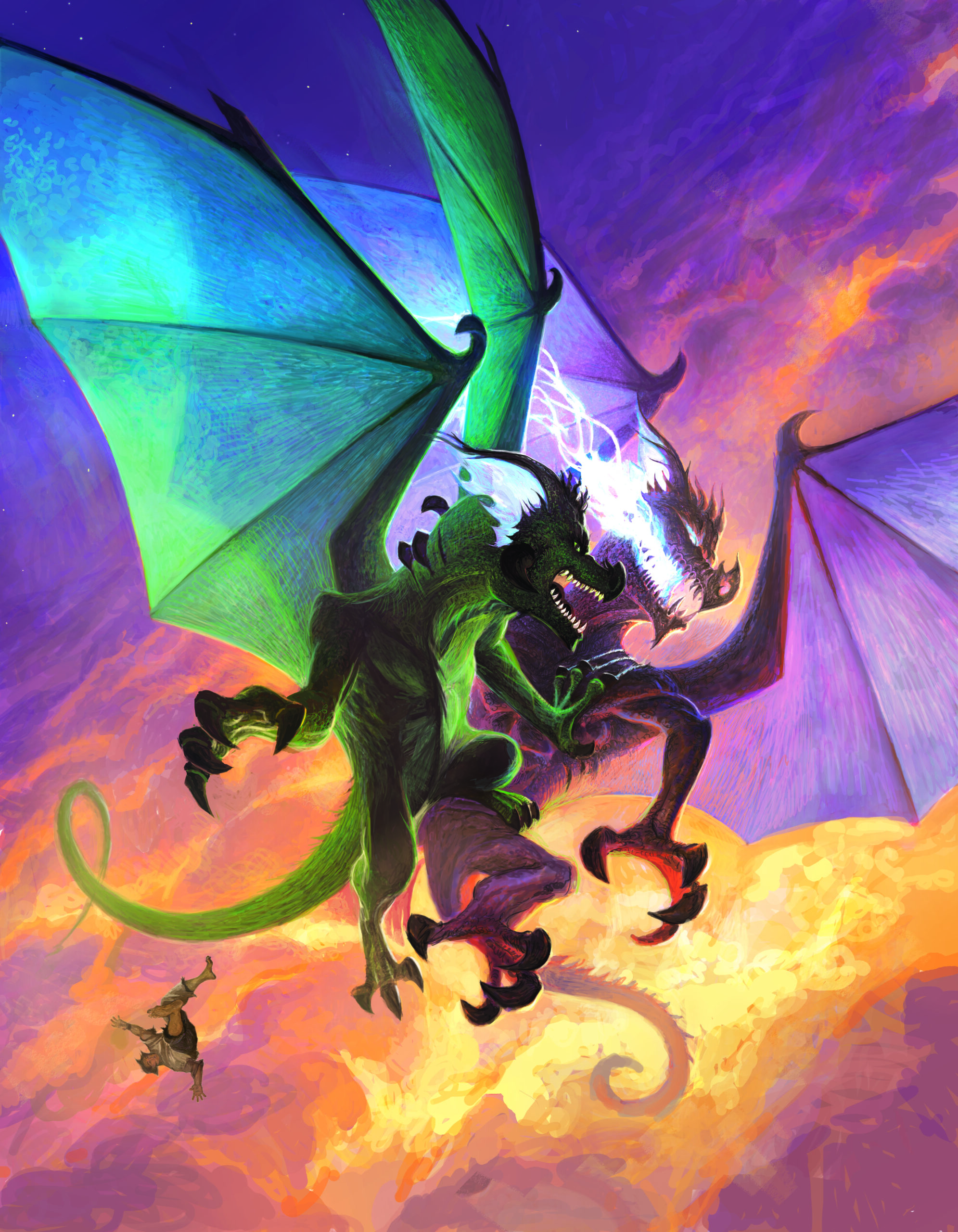
“The Ultimate Battle for Avalon: High in the stars, Basilgarrad fights the immortal Rhita Rawr,” Illustrated by August Hall for MERLIN: The Book of Magic, T. A. Barron
When Basil first appeared in my imagination, I knew he was anxious and far more talkative than he ought to be. I still had to learn what made him laugh, what he would hide, and whom he would trust. Those details took longer than choosing the color of his scales.
That is one of my absolute favorite elements of the writing life. A character can arrive in your imagination as a simple, static idea. But if you grant that character enough time, history, deep hopes, quiet fears, and the room to genuinely surprise you, something strange and wonderful happens.
The character begins to breathe. They feel alive.
Why Dragons Keep Changing
Across the centuries, dragons have changed with the people who told their stories, taking on the qualities each culture saw in the natural and spiritual world around it.
They appear as the fierce mušḫuššu on ancient Babylonian walls, as creatures of mist and rain in Chinese tradition, as feathered serpents linking earth and sky, as small beasts curled in the margins of medieval manuscripts, and as Smaug brooding beneath a mountain of gold.
And, of course, a dragon can begin like my own Basil — a small, clumsy creature who can’t yet see the grand destiny ahead of him.
Basil would probably object to being placed in the same sentence as an ancient Babylonian wall carving, a Chinese rain dragon, and the mighty Smaug. But I suspect he would thoroughly enjoy the company. After all, each of them belongs to a different era, shaped entirely by the people who imagined them into existence.
That may be the most beautiful thing about the long, winding history of dragons: an old creature can take on new scales in the hands of a new storyteller.
As long as human beings continue to look to the skies, wrestle with their own hidden fears, and long for a companion to share the journey, new dragons will always awaken.
And as for Basil? While he would be honored to take his place in this grand, unfolding tapestry of myth, he would also, undoubtedly, want to know what everyone was having for lunch.