
Before We Named Nature, We Told Its Story
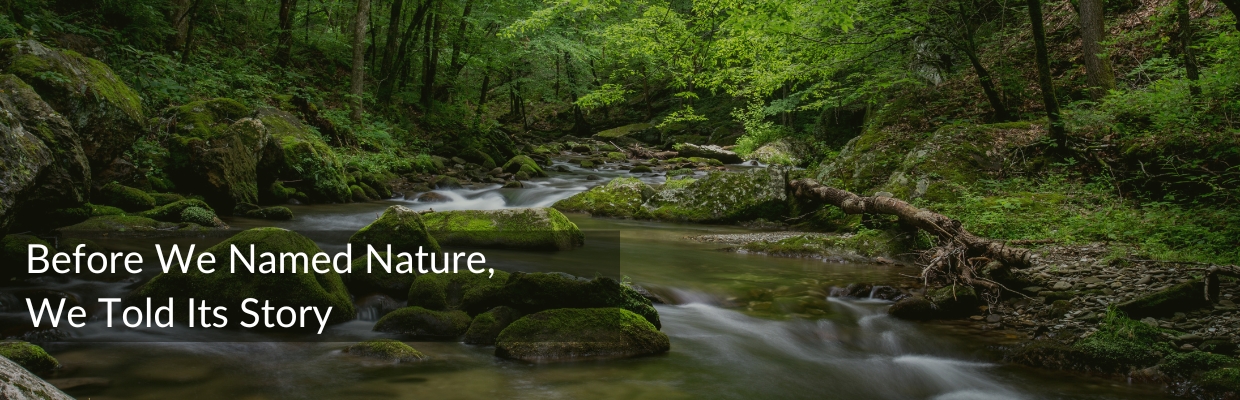
Long before we ever wrote words on a page, we spoke them beneath open skies. Stories weren’t born in classrooms or libraries. They rose beside rivers, around fires, and under constellations bright enough to command silence.
The natural world was never just a backdrop. It shaped the rhythm of language, the structure of myth, and the metaphors we still rely on today.
As I worked on my new book, Naming Nature, I kept returning to a simple truth: before we named the world, we stood before it in awe. We tried to make sense of it.
Story was our first attempt. Names came later.
Listening to the Land: Where Nature and Storytelling Begin
When I was a boy, my father led me to a tumbling stream on our Colorado ranch. We sat quietly beside the water.
“Hear the water?” he asked. “Hear its voice?”
I nodded.
“Well, if you sit here long enough and listen well enough, you’ll hear it hasn’t just one voice, but many. Like an orchestra.”
Despite my doubts, I turned back to the stream. For several minutes, I heard nothing new. Then, very slowly, I began to detect different sounds. High ones, like piccolos piping. Low ones, like bass drums pounding. Gurgles, splashes, rumbles, whistles, slaps, and more.
“There’s nothing,” my dad observed, “like having a good talk with the land.”
That lesson stayed with me.
Nature speaks in its own language, and stories are how we translate what we hear.
Across cultures and continents, people living close to the land developed stories that mirrored their surroundings. Desert communities told stories of endurance and scarcity. Forest cultures imagined spirits in trees. Island peoples traced myths across currents and tides. Mountain dwellers looked upward and told stories of height and peril.
The land doesn’t just inspire the stories; it shapes them.
That deep bond between nature and storytelling isn’t sentimental; it’s practical. Early humans depended on reading landscapes accurately. Stories encoded survival knowledge, like when floods would come, when animals migrated, and which stars marked planting season.
Myth was a form of memory. Story was how communities navigated the world, not just metaphorically but practically.
Nowhere is that clearer than when we look up.
The Sky as Our First Library
Consider the night sky.
I remember the very first time I saw the stars on a high mountain ridge in Colorado. It was a clear summer night, no artificial lights to distract from the vista. The evening was calm, but I could feel a gentle breeze, lighter than an owl’s feather, tousling my hair as I gazed up at the vast sky.
There were so many stars, all so bright, I almost had to squint just to look at them.
In that moment, I understood why humans have always told stories about the night sky.
We needed language for what we were seeing.
The constellations aren’t just clusters of distant suns. They’re the stories we told to remember where we were in the year, to navigate by, to pass the time on long winter nights. They’re memory tools. Calendars. Maps written in light.
Orion the hunter. Ursa Major, the great bear. The Pleiades, seven sisters. These names helped people remember seasons and directions. Indigenous peoples around the world developed their own star stories, each one reflecting their landscape and their needs. The same stars, different stories.
The sky became one of humanity’s earliest shared texts. Every culture learned to read it in its own language.
In doing so, they used stories to turn overwhelming vastness into something human and navigable.
Why Trees Anchor Our Myths
Certain elements of nature appear again and again in storytelling. Trees are among the most powerful.
That is no accident.
Trees connect earth and sky. They endure beyond human lifetimes. They mark time in visible rings and falling leaves. They stand still long enough for us to project memory and meaning onto them.
Some of my own earliest memories are tied to individual trees that stood like quiet companions in my childhood landscape. There was a massive oak near our house that I climbed so often I knew every branch, every hollow where birds nested, every place where the bark had scarred and healed.
That tree held stories.
My stories, certainly: the games I played, the books I read while perched in its branches, the storms I watched from its shelter. But older ones, too. It had been there before I was born. It would be there after I left.
Trees appear in stories across every culture. They occupy a space between earth and sky. They mark the passing of seasons. They outlive us.
They’re natural storytellers, if we know how to listen.
The Tree of Knowledge. Yggdrasil, the world tree. The Bodhi tree, where Buddha gained enlightenment. The sacred groves where druids gathered. These aren’t arbitrary symbols. They reflect something true about how trees function in our imagination and in our landscapes.
When I began writing The Ancient One over twenty years ago, I was on a solo hike in the Rockies. I came upon an ancient tree, weathered and twisted, clearly hundreds of years old. I stood there wondering what stories this tree could tell. What had it witnessed? What changes had occurred in its long life?
That tree became central to my novel. But the story didn’t come from my imagination alone. It came from standing in the presence of something that had endured, that had a history deeper than mine, that connected me to a time before I existed.
Nature offers raw material. Story shapes it.
Rivers, Movement, and Narrative Structure
Rivers appear in nearly every mythology. The River Styx that souls must cross. The Ganges, holy and purifying. The rivers of Eden. The floods that appear in dozens of cultures’ creation myths.
We tell stories about rivers because they move. They have a direction, a destination. They’re inherently narrative. A river is going somewhere, and we can follow it, and that journey will change us.
In the midst of nature, I often find peace beside a gently flowing river. The sounds of the water lapping at the banks and the wind rustling through the leaves create a soothing melody. There’s something about moving water that makes us reflective, that loosens the stories we carry inside.
My daughter understood this instinctively. When my father died, we sat at the supper table in silence, grief settling over us like snow. Then my five-year-old broke the quiet.
“I want to tell you my favorite thing that I ever did with Grandpa,” she said. “He took me down to the stream. We sat for a while by the water, then he showed me something special. He showed me that the stream has lots of voices. As many as an orchestra. And then he said, if you listen to those voices, listen your very best, the stream will tell you all the places it has ever been. And all the places it might someday go.”
All the places it might someday go.
That’s what rivers do in stories. They carry us forward. They promise transformation. They suggest that the story isn’t over yet.
That’s narrative at its core. Past. Present. Future. Flow.
What We Lose When We Lose the Wild
Today, many people live far from wild landscapes. We navigate streets more often than trails. Our nights glow with screens instead of stars.
Yet our appetite for stories rooted in nature has not faded. Fantasy novels still teem with forests and mountains. Nature documentaries draw millions. National parks fill with visitors seeking something they cannot quite name.
Why does that hunger remain?
Because the structure of storytelling itself was shaped outdoors. Conflict and calm mirror weather patterns. Character growth follows seasonal rhythms. Climaxes resemble storms. Resolution echoes return.
For most of human history, storytelling wasn’t entertainment. It was how communities preserved ecological knowledge and passed it forward.
When we disconnect from wild places, we risk losing access to the metaphors that ground our narratives. We risk thinning our imaginative vocabulary.
In Naming Nature, I explore how the names we give to plants, animals, and landscapes carry embedded stories — bits of history, observation, humor, and wisdom compressed into a word or two. But even before naming comes noticing. And before noticing comes being present.
Without attention, neither language nor story can take root.
How to Reconnect Story to the Natural World
If you want to discover the stories that nature tells, here’s what I’ve learned:
- Go outside. Not to exercise or take a photo, but to pay attention. Sit somewhere for longer than feels comfortable. Let the place reveal itself.
- Listen. Not just with your ears, but with your whole body. What sounds do you hear? What rhythms? What silences?
- Ask questions. Why does this tree grow crooked? What made this stone smooth? Where does this trail lead? Every feature of a landscape has a history. Most of that history is a story waiting to be discovered.
- Read the old stories. Myths and folktales aren’t primitive superstition. They’re how humans have always made sense of the natural world. The more you read them, the more you’ll see the patterns — the same observations appearing in different cultures, the same truths expressed in different languages.
- Tell your own stories. When something in nature catches your attention, don’t just photograph it. Ask yourself why it matters. What does it remind you of? What feeling does it evoke? That’s the beginning of a story.
The Stories That Endure
The strongest stories, the ones that last for generations, are the ones rooted in the natural world.
They endure because they’re based on observations that remain true.
Rivers still flow.
Trees still grow.
Stars still wheel overhead.
Seasons still turn.
The land speaks in a language older than words. Stories are how we learn to understand what it’s saying.
When I sit down to write, whether about Merlin or nature, I feel the presence of ancient storytellers who sat beside their own fires and streams and mountains. They told stories to make sense of where they were, who they were, and how they fit into the world around them.
We are doing the same thing now.
The impulse hasn’t changed. Only the setting has.
Before we named nature, we told its story. If we want our words to carry depth and resilience, we would do well to keep listening to the land that first taught us how to speak.